
For thousands of international dentists every year, the dream of practicing in the United States begins with one examination—the Integrated National Board Dental Examination (INBDE®).
Unlike traditional dental board exams that focused heavily on memorization, the INBDE evaluates how well you can apply scientific knowledge, interpret clinical information, and make safe patient-care decisions.
Whether you’re a recent BDS graduate, an experienced dentist, or preparing for an Advanced Standing DDS/DMD program, understanding the INBDE is your first step toward a U.S. dental career.
What is the INBDE?
The Integrated National Board Dental Examination (INBDE) is the national written dental licensure examination administered by the Joint Commission on National Dental Examinations (JCNDE), an agency of the American Dental Association (ADA).
It replaced both:
- NBDE Part I
- NBDE Part II
with a single integrated examination that reflects modern dental education and clinical practice.
Why Was the INBDE Introduced?
Modern dentistry requires dentists to think clinically rather than recall isolated facts.
Instead of asking questions subject by subject, the INBDE combines:
- Basic sciences
- Clinical sciences
- Ethics
- Patient management
- Evidence-based dentistry
into realistic patient scenarios that mirror everyday practice.
You are eligible if you are:
- A student in a CODA-accredited dental school
- A graduate of a CODA-accredited dental school
- An internationally trained dentist who fulfills JCNDE eligibility requirements
International graduates from non-CODA schools must submit a Certification of Eligibility signed by the dean or registrar of their dental school.
INBDE Exam Pattern (2026)
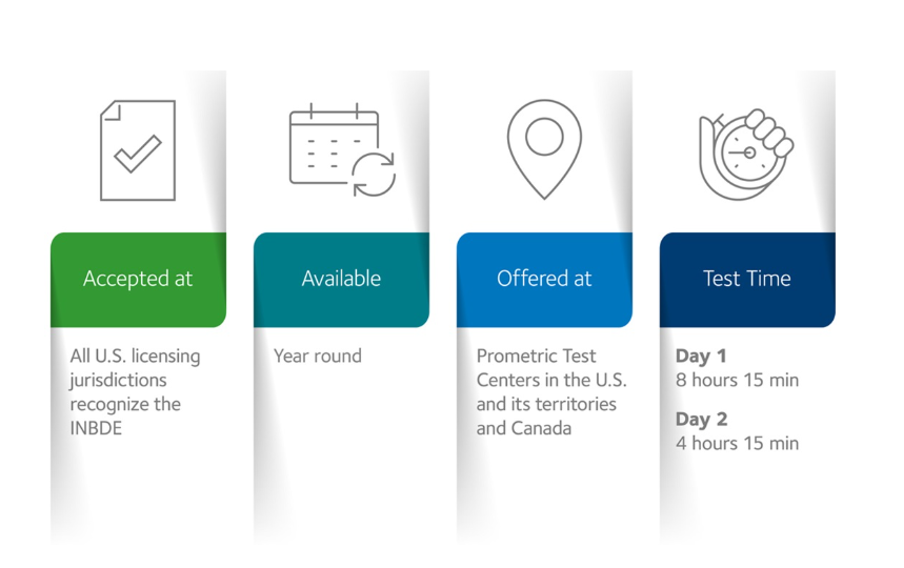
The INBDE is conducted over 2 days.
Day 1
- Approximately 360 questions
- Includes standalone questions and patient-box questions
- Focuses on foundational knowledge integrated with clinical decision-making
Day 2
- Approximately 140 questions
- Primarily case-based items built around detailed patient scenarios
- Emphasizes diagnosis, treatment planning, patient management, and clinical judgment
Total Questions: Approximately 500 multiple-choice questions. Some items are pretest questions that do not contribute to the score but are indistinguishable from scored questions.
Official INBDE Domain of Dentistry (2026)
The Integrated National Board Dental Examination (INBDE) evaluates candidates through the Domain of Dentistry, which integrates biomedical sciences, clinical sciences, and behavioral sciences instead of testing individual subjects separately.
The Domain consists of:
- 56 Clinical Content Areas
- 10 Foundation Knowledge Areas
The Clinical Content Areas are divided into three major domains.
Domain 1: Diagnosis and Treatment Planning (Clinical Content Areas 1–15)
This domain evaluates your ability to collect, interpret, and analyze patient information to establish a diagnosis and develop an appropriate treatment plan.
Topics Covered
- Interpret patient information and medical data.
- Identify the chief complaint.
- Perform head, neck, and intraoral examinations.
- Diagnose dental abnormalities and pathology.
- Recognize normal versus abnormal clinical findings.
- Predict diagnostic outcomes.
- Interpret diagnostic test results.
- Recognize manifestations of systemic diseases.
- Understand oral-systemic health relationships.
- Select appropriate diagnostic tools.
- Collect information from multiple healthcare sources.
- Formulate comprehensive treatment plans.
- Discuss diagnosis, treatment options, and prognosis with patients.
- Consider patient age, sex, ethnicity, culture, and special needs.
- Communicate effectively using behavioral and psychological principles.
Domain 2: Oral Health Management (Clinical Content Areas 16–38)
This is the largest and most heavily tested domain. It focuses on delivering safe, comprehensive patient care and managing dental diseases and procedures.
Topics Covered
- Medical emergencies.
- Dental emergencies.
- Orofacial trauma, pain, infection, and hemorrhage.
- Pain management.
- Pulpal and periradicular diseases.
- Dental caries.
- Periodontal diseases.
- Oral mucosal and bone diseases.
- Patient abuse and neglect.
- Substance abuse.
- Pharmacological management.
- Drug complications and adverse reactions.
- Endodontic diagnosis and treatment.
- Restorative needs of partially and completely edentulous patients.
- Restoration of tooth function, structure, and esthetics.
- Fixed, removable prosthodontics and implant procedures.
- Oral surgery diagnosis and treatment planning.
- Oral surgical procedures.
- Occlusal disorders.
- Temporomandibular disorders (TMD).
- Soft tissue modification for esthetics and function.
- Evaluation of treatment outcomes.
- Esthetic dentistry management.
Domain 3: Practice and Profession (Clinical Content Areas 39–56)
This domain assesses professionalism, ethics, communication, evidence-based dentistry, and practice management.
Topics Covered
- Emerging healthcare trends.
- Social and economic influences on oral healthcare.
- Evidence-based dentistry and scientific literature.
- Referral and consultation.
- Technology and healthcare resources.
- Risk management and legal responsibilities.
- Ethics and jurisprudence.
- Patient record maintenance.
- Practice management and financial operations.
- Disaster preparedness.
- Supervision of allied dental personnel.
- Self-assessment and professional development.
- Infection prevention and control.
- Prevention and patient education.
- Interprofessional collaboration.
- Community oral healthcare.
- Quality assurance and quality improvement.
- Communication with dental laboratories.
Foundation Knowledge Areas (FK)
The INBDE also integrates 10 Foundation Knowledge Areas that support clinical decision-making. These are not tested as separate subjects but are embedded throughout patient-based questions.
| FK No. | Foundation Knowledge Area |
| FK1 | Molecular, biochemical, cellular, and systems-level development, structure, and function |
| FK2 | Physics and chemistry in normal biology and pathobiology |
| FK3 | Physics and chemistry of dental materials and technologies |
| FK4 | Genetics, congenital and developmental diseases |
| FK5 | Immunology and host defense mechanisms |
| FK6 | General and disease-specific pathology |
| FK7 | Microbiology |
| FK8 | Pharmacology |
| FK9 | Behavioral sciences, ethics, and jurisprudence |
| FK10 | Research methodology, biostatistics, evidence-based dentistry, and informatics |
Official INBDE Test Specification (2026)
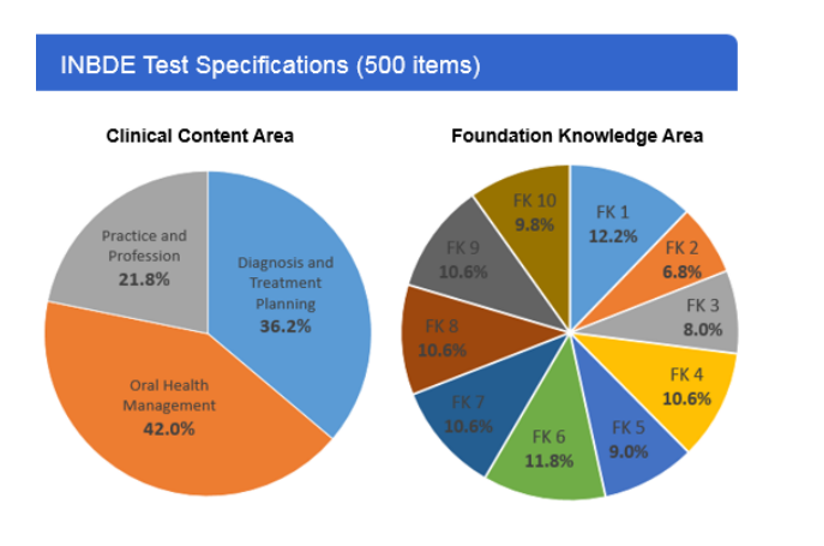
The JCNDE allocates examination questions approximately as follows:
| Domain | Approximate Weight |
| Diagnosis & Treatment Planning | 36% |
| Oral Health Management | 42% |
| Practice & Profession | 22% |
This structure reflects the INBDE’s emphasis on integrated clinical reasoning, where foundational sciences are applied to diagnose, plan, and manage patient care rather than being tested as standalone subjects.
Question Format
The INBDE uses several question types:
- Single best-answer multiple-choice questions
- Patient-box (case-based) questions
- Radiograph interpretation
- Clinical photographs
- Medical and dental history interpretation
- Sequential case questions
The examination emphasizes clinical reasoning, not rote memorization.
How Is the Exam Scored?
One of the most common questions is:
“What marks do I need to pass?”
The answer is:
The ADA and JCNDE do not publish a numerical passing mark.
The INBDE uses a Pass/Fail scoring system.
Candidates receive:
- PASS, or
- FAIL
No percentage score or rank is provided.
The examination uses psychometric standard setting rather than a fixed percentage cutoff.
Is There Negative Marking?
No.
There is no penalty for incorrect answers.
Because unanswered questions receive no credit, candidates are encouraged to answer every question.
INBDE Examination Fees (2026)
According to the official 2026 Candidate Guide:
| Fee | Amount (USD) |
| INBDE Examination Fee | $890 |
| International Candidate Processing Fee (Non-CODA graduates) | $435 |
| Additional Score Report | $55 |
| Results Audit | $105 |
| Eligibility Extension (45 days) | $150 |
The examination fee includes score reporting to the candidate, their dental school (where applicable), and up to three licensing jurisdictions selected at the time of application. Fees are non-refundable and non-transferable.
How to Apply
The application process includes:
- Create or retrieve your DENTPIN® https://www.ada.org/education/manage-your-dentpin
- Review the official Candidate Guide
- Submit your INBDE application
- Upload required documents
- Submit a Certification of Eligibility (if applicable)
- Receive your eligibility email
- Schedule your examination through Prometric
The JCNDE recommends scheduling your test 60–90 days in advance
Where Is the Exam Conducted?
The INBDE is administered at authorized Prometric testing centers throughout:
- United States
- U.S. Territories
- Canada (excluding Quebec)
How Long Is the Eligibility Period?
Once approved, candidates receive an eligibility period during which they must schedule and complete the examination. If needed, a one-time 45-day eligibility extension is available for an additional fee.
Retake Policy
Candidates who do not pass:
- Must wait at least 60 days before retaking the exam.
- Must pass within the JCNDE’s 5 Years / 5 Attempts Rule—whichever limit is reached first. After that, additional restrictions apply.
When Are Results Released?
Results are generally available approximately 3–4 weeks after the examination through the candidate’s DENTPIN account.
Official Study Resources
The JCNDE provides:
- Official Candidate Guide
- Practice Questions
- Acronyms & Abbreviations Guide
- Webinar Recordings
- Day-of-Test Checklist
These should form the foundation of every candidate’s preparation
The INBDE is more than a licensing examination—it is a measure of whether a future dentist can think critically, integrate scientific knowledge, and make safe clinical decisions. For international dentists pursuing a career in the United States, understanding the exam pattern, scoring system, fees, and official requirements is the first step toward success.
Reference