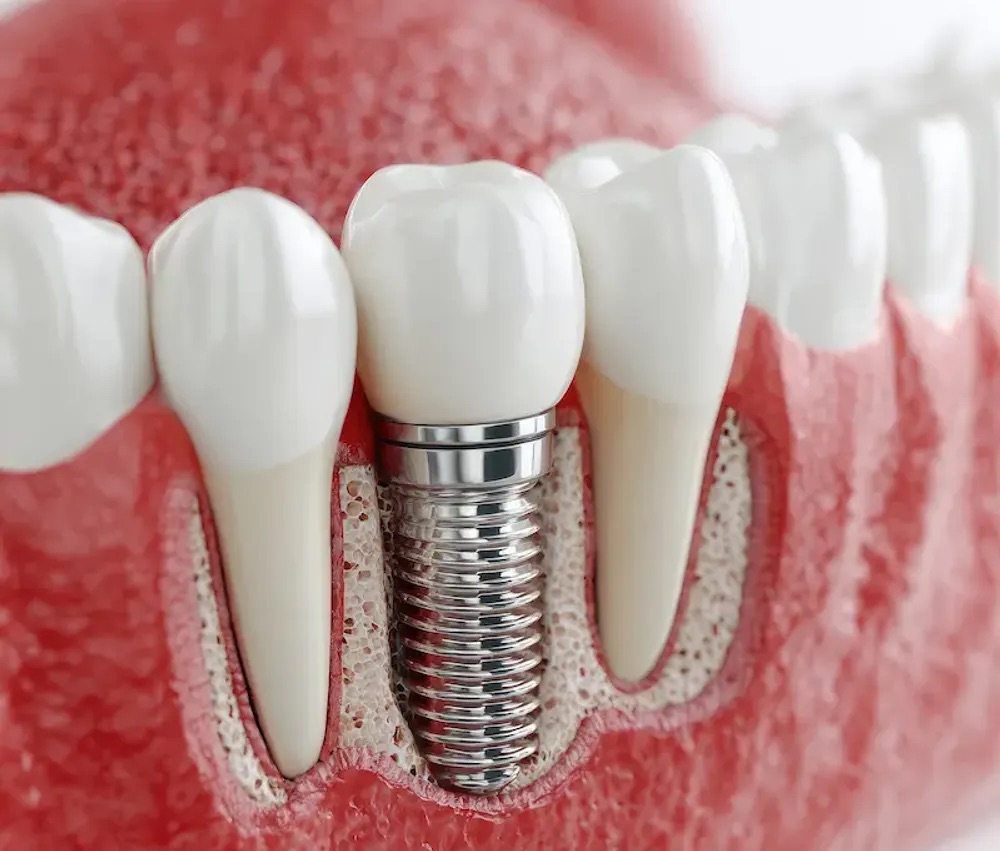
Dental implants have revolutionized dentistry, restoring smiles and function for millions. Yet, their long-term success relies on strong bone integration and effective load handling. To address this, researchers have developed an innovative bilayered implant that blends engineering strength with bone-friendly design
Unlike conventional implants made entirely of titanium, the new design features a titanium alloy core for strength and durability, surrounded by a porous outer layer composed of titanium and hydroxyapatite (HA). This porous shell mimics natural bone, allowing better load distribution and encouraging bone cells to grow into the implant, improving osseointegration—the critical process of bonding between bone and implant.
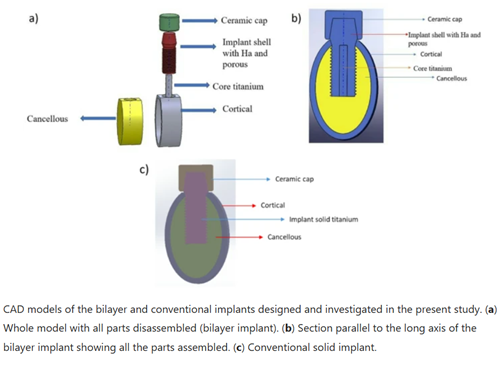
To evaluate their design, the researchers used SolidWorks 2017 to create detailed 3D models of both conventional and bilayered implants, along with a segment of the mandibular bone. They then ran Finite Element Analysis (FEA) in ANSYS Workbench, applying a 250 N axial compressive load to assess how the implants would behave under realistic chewing forces. Key design parameters were systematically varied:
- Porosity of the outer layer: 10%–90%
- Hydroxyapatite content: 10%–50%
- Outer layer thickness: 1 mm, 1.5 mm, and 2 mm
The team focused on two important outcomes: von Mises stress, which indicates where the implant or surrounding bone may experience harmful forces, and interfacial strain, which reflects how the bone responds to mechanical loading.
Key Findings:
- Significant Stress Reduction: Porous bilayered implants dramatically reduced stress concentrations, achieving up to 94% lower von Mises stress compared to conventional titanium implants. Even non-porous bilayered designs showed substantial reductions (72–90%), though porous versions performed slightly better.
- Optimal Configuration: The analysis revealed that a 2 mm titanium core with a 2 mm porous Ti-HA outer layer provided the best balance between mechanical strength and favorable bone strain. This combination allowed for efficient load transfer, minimizing the risk of bone overload and potential implant failure.
- Enhanced Bone-Implant Interaction: The porous outer layer encourages bone ingrowth, promoting better osseointegration while distributing chewing forces more evenly. This design reduces stress concentration at critical points and supports long-term implant stability.
According to the researchers, this bilayered approach represents a promising step forward in dental implant technology, merging material science, mechanical engineering, and biological principles. While the study used advanced computational modeling to predict performance, the team emphasizes that experimental validation and clinical testing are needed to confirm these results in real patients and under varying conditions.
Reference
Article title: In silico study of a bilayer titanium dental implant with a porous titanium and hydroxyapatite composite outer layer for enhanced osseointegration
Scientific Reports, volume 16, Article 1310 (2026)
https://doi.org/10.1038/s41598-025-31030-0