“What if one of the biggest breakthroughs in dental implant success didn’t require a new implant—but just 20 seconds of ultraviolet light?”
Dental implants have transformed millions of smiles, but every implant faces one crucial challenge before it can last for decades—successful osseointegration, the biological process where bone fuses firmly with the titanium implant.
Now, researchers are exploring a remarkably simple innovation that could accelerate this process: Ultraviolet (UV) photofunctionalization.
Why Do Dental Implants Sometimes Take Time to Heal?
Although titanium is considered the gold standard for dental implants, it undergoes a phenomenon known as “biological aging.”
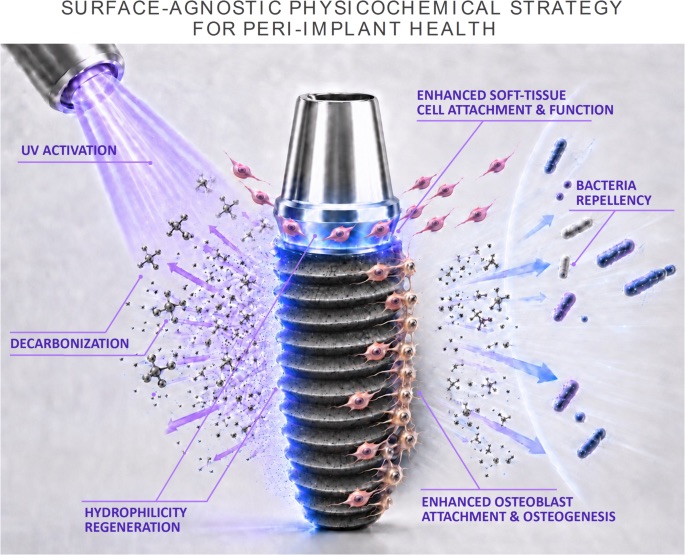
Over time, even before an implant is placed inside the patient’s jaw, microscopic hydrocarbon contaminants naturally accumulate on its surface during storage. These contaminants reduce the implant’s ability to attract proteins and bone-forming cells, potentially slowing the healing process.
Imagine trying to paint on a dusty wall instead of a clean one—the paint won’t stick as well. The same concept applies to bone cells trying to attach to an aged implant surface.
The 20-Second Solution
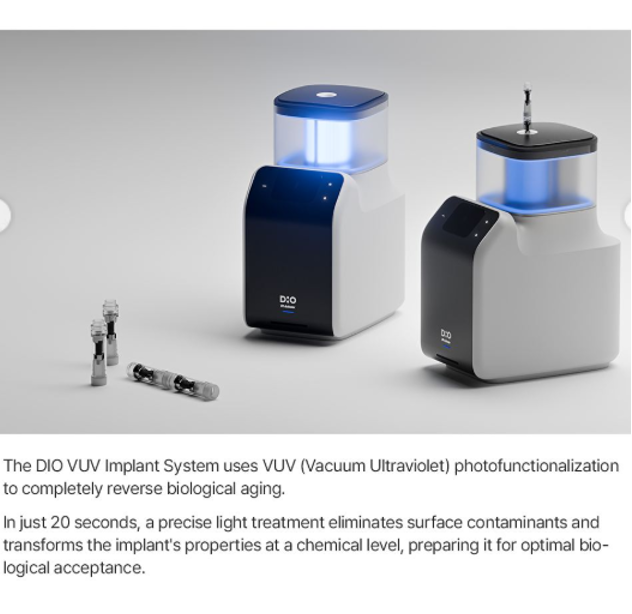
Researchers have discovered that exposing titanium implants to ultraviolet (UV) light for just 20 seconds immediately before placement can dramatically change the implant surface.
This quick chairside procedure:
- Removes accumulated hydrocarbon contaminants
- Restores the implant’s surface cleanliness
- Makes the titanium superhydrophilic (extremely attractive to water and blood)
- Improves protein attachment
- Encourages faster bone cell adhesion
- Supports earlier bone formation around the implant
The implant itself doesn’t change—its surface simply becomes biologically “younger” and more active.
What Did the Clinical Trial Find?
A randomized, double-blinded clinical trial involving 24 patients receiving mandibular dental implants compared conventional titanium implants with UV-treated implants.
The findings were encouraging.
Faster Implant Stability
Immediately after surgery, both groups showed similar stability. However, by:
- 8 weeks, UV-treated implants demonstrated significantly greater stability.
- 4 months, the difference became even more pronounced, indicating stronger bone attachment.
This suggests that UV treatment mainly enhances secondary stability—the stage where new bone actively bonds with the implant.
Less Bone Loss Around the Implant
One of the biggest indicators of long-term implant success is preservation of the surrounding crestal bone.
Patients receiving UV-treated implants experienced:
- Lower mesial bone loss
- Lower distal bone loss
- Better preservation of supporting bone during healing
Maintaining bone height is essential for both implant longevity and esthetic outcomes.
Healthy Soft Tissues
Perhaps equally important, UV treatment did not increase inflammation or negatively affect gum healing.
Both groups showed healthy peri-implant soft tissues throughout the healing period, indicating that the technique is safe while offering biological advantages.
Why Does UV Light Work?
The secret lies in surface chemistry.
Ultraviolet light removes organic contaminants while altering the titanium dioxide layer on the implant surface. This creates an environment that attracts proteins like fibronectin and vitronectin—key molecules that guide bone-forming cells to attach and begin building new bone.
The result is a stronger and faster connection between bone and implant.
What Does This Mean for Patients?
Although UV photofunctionalization is still gaining wider clinical adoption, it has exciting potential, particularly for:
- Immediate and early loading protocols
- Patients with compromised bone quality
- Cases requiring highly predictable osseointegration
- Medically compromised individuals
- Situations where reducing healing time is desirable
Because the procedure takes only 20 seconds and is performed immediately before implant placement, it can be incorporated into routine implant workflows without adding significant treatment time.
The Future of Implant Dentistry May Be Brighter Than Ever
Modern dentistry continues to move toward biologically smarter treatments rather than simply mechanically stronger ones.
UV photofunctionalization represents exactly that philosophy—using a brief burst of ultraviolet light to reactivate the implant surface and help nature do its job more efficiently.
While larger multicenter studies are still needed to confirm long-term outcomes, current clinical evidence suggests that this simple technology could become an important advancement in improving implant success.
Sometimes, the future of dentistry isn’t about inventing a completely new implant.
Sometimes, it’s simply about letting a little light do the work.
Reference
Effect of Ultraviolet Photofunctionalization on Early Osseointegration of Titanium Dental Implants in the Mandibular Region: A Randomized Controlled Trial