If you’re using an at-home teeth whitening kit, chances are you’re also using a mouthwash as part of your daily oral hygiene routine. But have you ever wondered whether your mouth rinse could affect the whitening results—or even your tooth enamel?
A new study published in Odontology (2026) investigated exactly that. Researchers evaluated whether commercially available mouth rinses with different active ingredients influence enamel properties during at-home bleaching treatment. Their findings offer valuable insights for both dental professionals and patients undergoing whitening procedures.
Why This Study Matters
At-home bleaching has become one of the most popular cosmetic dental treatments because it is convenient, affordable, and effective. However, bleaching agents such as hydrogen peroxide can temporarily alter enamel by reducing its hardness and changing its surface characteristics.
Since many people continue using mouthwash throughout the whitening process, researchers wanted to determine whether different mouth rinse formulations could further influence enamel health or interfere with whitening effectiveness.
How Was the Study Conducted?
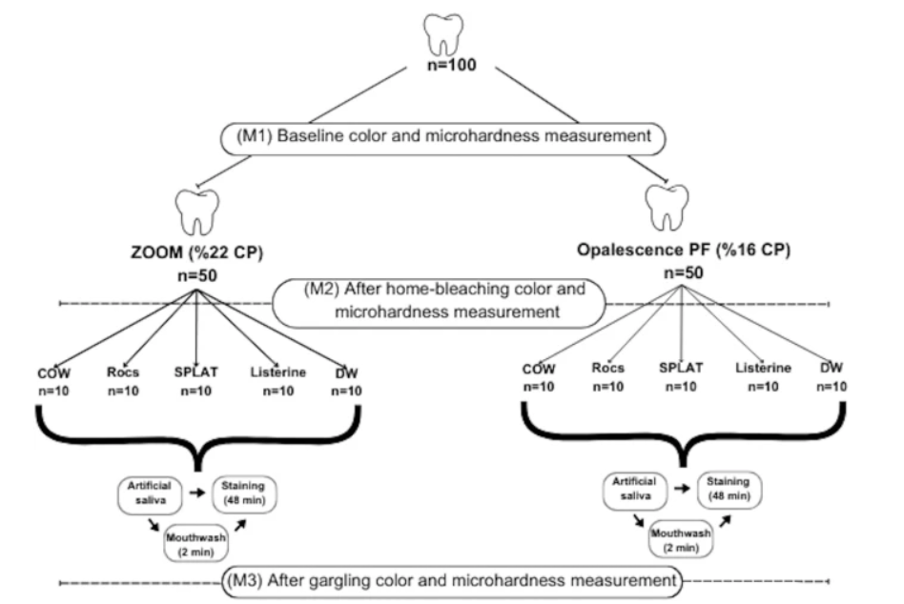
Researchers evaluated enamel specimens that underwent an at-home bleaching protocol while being exposed to different commercially available mouth rinses containing various active ingredients.
Bleaching Protocol
- Bleaching was performed 4 hours per day for 14 consecutive days.
- Mouth rinses were used twice daily during the treatment period.
The researchers measured several important enamel characteristics before and after bleaching, including:
- Color change
- Surface roughness
- Microhardness
- Surface morphology using Scanning Electron Microscopy (SEM)
The collected data were analyzed using statistical models to determine whether different mouthwash formulations produced measurable differences.
What Did the Researchers Find?
The results showed several important findings.
1. Mouthwash Did Not Reduce Whitening Effectiveness
One of the most reassuring outcomes was that none of the tested mouth rinses affected the whitening results.
Regardless of the formulation used, the degree of tooth color improvement remained similar across all groups.
Takeaway: Patients can continue using mouthwash during bleaching without worrying that it will reduce whitening effectiveness.
2. Bleaching Reduced Enamel Microhardness
Although whitening effectiveness remained unchanged, all groups demonstrated a significant reduction in enamel microhardness after treatment.
This suggests that bleaching itself temporarily affects enamel strength, irrespective of the mouthwash being used.
3. Some Mouthwashes Increased the Reduction in Hardness
Researchers observed that two mouth rinse formulations (identified in the study as CMZ and CM) showed the greatest reduction in enamel microhardness by the end of the evaluation period.
This indicates that certain active ingredients may influence how enamel responds after bleaching.
4. Surface Changes Were Seen Under the Microscope
Scanning Electron Microscopy revealed similar surface alterations across all groups.
These included:
- Small surface depressions
- Increased porosity
- Minor morphological changes
While these microscopic changes were observed after bleaching, their appearance was generally similar regardless of the mouthwash used.
What Does This Mean for Dentists?
For clinicians providing home whitening treatments, the findings suggest that:
- Routine use of mouthwash is unlikely to compromise bleaching outcomes.
- Patients should still be informed that temporary changes in enamel hardness may occur during whitening.
- The choice of mouth rinse may influence enamel properties, particularly microhardness, depending on its active ingredients.
- Post-whitening remineralization strategies may be beneficial for maintaining enamel integrity.
The good news is that using mouthwash during at-home teeth whitening does not appear to reduce whitening effectiveness or alter the final tooth color. However, bleaching can temporarily reduce enamel microhardness, and certain mouth rinse formulations may contribute to greater changes in enamel properties.
As cosmetic dentistry continues to evolve, understanding how everyday oral care products interact with whitening treatments will help dentists provide safer and more personalized recommendations.
Reference
Coelho TN, Gil AJ, Benati MRL, et al. Influence of commercial mouth rinses with different formulations on enamel properties during at-home bleaching. Odontology. 2026.