
New research suggests cigarette smoke exposure early in life may alter the microscopic mineralization of developing tooth enamel.
We usually think of secondhand smoke as a lung and respiratory health problem.
But what if its effects begin somewhere much closer to the smile?
A new study from researchers at the University of São Paulo’s Ribeirão Preto School of Dentistry (FORP-USP) has raised an intriguing possibility: exposure to secondhand cigarette smoke during early life may alter the mineralization and chemical composition of developing tooth enamel—even when the teeth look completely normal.
And that could have important implications for pediatric dentistry and oral health research.
The Teeth Looked Normal. Under the Microscope, They Didn’t.
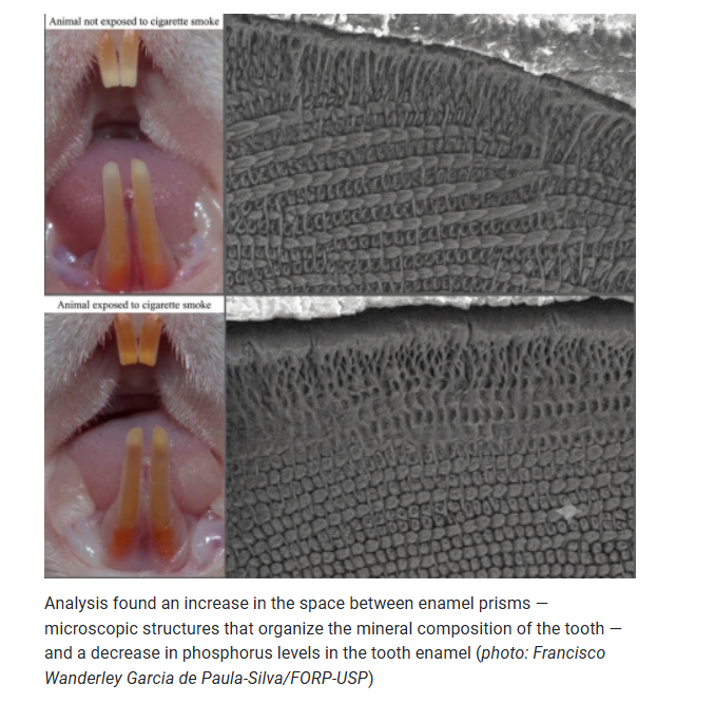
In the study, researchers exposed young rats to cigarette smoke for five minutes twice a day from the second through the 28th day of life.
When the animals’ teeth were examined with the naked eye, researchers found no significant visible differences.
But microscopic and chemical analysis told a different story.
The smoke-exposed animals showed:
- Increased spacing between enamel prisms
- Reduced phosphorus levels in enamel
- Increased carbon content
- Changes suggesting altered enamel mineralization and maturation
These findings are particularly interesting because enamel is an extremely highly mineralized tissue and does not remodel in the same way as bone after it forms.
Why Is Phosphorus So Important?
To understand why the findings matter, we need to look at hydroxyapatite.
Hydroxyapatite is a major mineral component responsible for the hardness of dental enamel. Phosphorus is an important part of this mineral structure.
The researchers observed lower phosphorus levels in the enamel of smoke-exposed animals.
They also detected an increase in carbon content.
According to the researchers, these chemical changes could potentially influence properties such as enamel strength, hardness and resistance to wear or fracture.
Interestingly, however, the study did not find an initial reduction in enamel hardness.
That creates another fascinating question:
Why Early Childhood Could Be a Critical Window
Dental enamel doesn’t develop all at once.
Different teeth undergo formation and mineralization at different stages of life.
Baby teeth begin forming during pregnancy, while much of the mineralization of permanent teeth occurs during childhood.
That makes childhood a potentially important period for environmental influences on developing teeth.
The researchers are examining this through the lens of the Developmental Origins of Health and Disease (DOHaD) concept—the idea that exposures during early development can influence health later in life.
And enamel has a unique feature.
Once enamel is formed, it doesn’t remodel like bone.
That means enamel can potentially preserve clues about conditions experienced during the period when it was developing.
Researchers describe it almost like a biological record of early-life exposure.
Could This Be Connected to Molar-Incisor Hypomineralization?
This is where the research becomes particularly relevant to pediatric dentistry.
Molar-incisor hypomineralization (MIH) is a developmental enamel defect in which affected enamel can be more fragile and susceptible to breakdown and caries.
The researchers suggest that their findings raise the possibility that early exposure to cigarette smoke could contribute to enamel-development defects seen in children.
But there is a crucial caveat:
The study does NOT prove that secondhand smoke causes MIH in children.
The researchers themselves describe this as a hypothesis requiring further investigation.
That distinction is essential.
The current findings come from an animal model, not a human clinical study.
How Was the Study Conducted?
The researchers divided young rats into two groups.
One group was exposed to cigarette smoke for five minutes twice daily, from day 2 through day 28 of life.
The other group served as an unexposed control.
The animals were monitored for growth and dental development.
Although visible examination did not reveal major differences, researchers then used microscopic and chemical analyses to investigate the enamel in greater detail.
This highlights an important lesson in dental research:
Some developmental changes may be invisible to the naked eye long before they become clinically obvious.
The Research Is Already Moving Forward
The team has begun another phase of research involving more prolonged smoke exposure.
The goal is to determine whether greater exposure produces more pronounced changes in enamel structure and whether those changes can resemble defects observed clinically in humans.
Researchers are also investigating which stage of enamel formation is most affected.
Their current findings suggest that smoke exposure may primarily interfere with the mineralization and maturation stage, rather than simply reducing enamel thickness.
What Does This Mean for Dentists?
For pediatric dentists, this research reinforces the importance of looking beyond visible cavities and obvious enamel defects.
Developing teeth are influenced by their environment, and researchers are increasingly investigating how early-life exposures can affect oral development.
However, this study should not be interpreted as evidence that secondhand smoke directly causes enamel defects or MIH in human children.
Instead, it provides a biological clue that warrants further investigation.
For clinicians, the broader message is simple:
Early-life exposures may leave biological signatures in developing teeth—even when those changes aren’t immediately visible.
A New Reason to Think About Secondhand Smoke
The health risks of tobacco smoke are already well established.
This research adds another intriguing dimension: developing teeth may also be affected at the microscopic level.
And because enamel doesn’t remodel after formation, researchers believe it could potentially preserve information about exposures that occurred during critical developmental periods.
But before we draw conclusions about human children, more research is needed.
The teeth in this study didn’t look damaged.
The microscope told a different story.
And that may be the most interesting finding of all.
Reference
Impact of Secondhand Smoke on the Biomineralization of Dental Enamel in Rats
Calcified Tissue International (2026)
https://pubmed.ncbi.nlm.nih.gov/42101651/