What if severe tooth pain had nothing to do with the tooth?
A recent case highlights an unusual but clinically important possibility: an acute ischemic stroke can, in rare circumstances, present as isolated toothache-like pain. The case involved a 52-year-old man who arrived at the emergency department with sudden, severe pain on the left side of his teeth. At first glance, this sounded like a routine dental problem. But the examination revealed a very different story.
The Patient Thought It Was a Tooth Problem
The patient experienced intense, continuous left-sided dental pain that he perceived as originating from his teeth.
His medical history, however, contained important clues. He had:
- Arterial hypertension
- A previous ischemic stroke in 2018
- Moderate tobacco use
- Moderate alcohol use
There was no recent dental procedure, trauma, fever, facial swelling or systemic evidence of infection.
The dental examination was equally revealing.
There was no convincing evidence of:
- Dental abscess
- Gingival swelling
- Facial cellulitis
- Percussion tenderness
- Other obvious odontogenic pathology
Even more surprisingly, the neurological examination did not show the classic signs clinicians might expect from an acute stroke. There was no facial weakness, speech disturbance, limb weakness, ataxia, visual-field deficit or definite sensory loss.
The Imaging Changed Everything
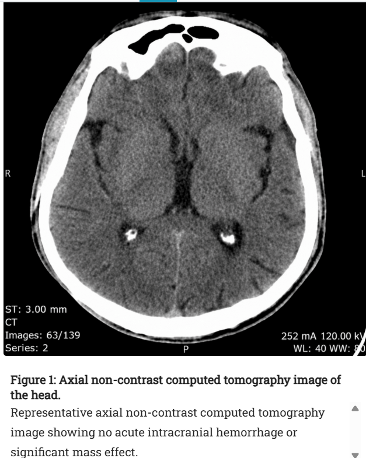
A non-contrast CT scan did not show intracranial hemorrhage.
But because the patient’s symptoms were sudden and unexplained, further neurological evaluation was performed.
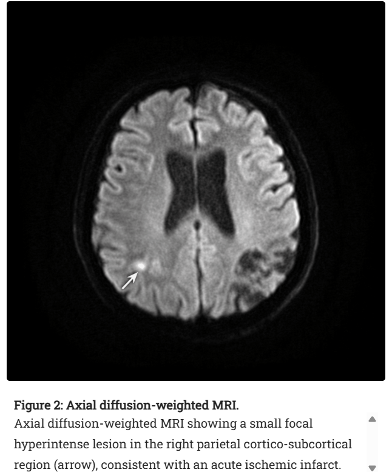
Diffusion-weighted MRI revealed an acute right parietal cortico-subcortical ischemic lesion.
The apparently dental pain was actually associated with a right-sided brain infarction, producing pain perceived on the opposite side of the face and teeth.
How Can a Stroke Feel Like a Toothache?
This is what makes the case particularly fascinating.
Pain from the teeth and other oral structures is transmitted through the trigeminal sensory system and ultimately reaches several areas of the brain involved in processing and interpreting pain.
The parietal region, particularly the postcentral gyrus and surrounding somatosensory association areas, plays an important role in localizing and interpreting sensory information.
If an ischemic lesion disrupts these networks, abnormal brain activity may potentially be interpreted as pain coming from a peripheral structure such as a tooth—even when the tooth itself is healthy.
Functional imaging research has also demonstrated that tooth pain activates cortical regions including the primary and secondary somatosensory cortices, insula and cingulate cortex.
So the patient wasn’t imagining the pain.
The pain was real—but its source was central rather than dental.
The Diagnostic Trap for Dentists
This case presents a challenging clinical scenario.
When a patient arrives complaining of severe toothache, the first differential diagnoses naturally include common dental conditions such as:
- Acute pulpitis
- Dental abscess
- Periodontal disease
- Cracked tooth syndrome
But unexplained or atypical orofacial pain can have several non-odontogenic causes, including:
- Trigeminal neuralgia
- Trigeminal neuropathy
- Temporomandibular disorders
- Sinus disease
- Herpes zoster
- Migraine-associated facial pain
- Central neuropathic pain
- Neurological disease, including stroke
The key lesson is not that every toothache should trigger brain imaging.
It is that a severe, sudden-onset dental pain with no convincing dental explanation deserves a second look.
A Normal CT Does Not Always End the Investigation
Another important lesson from the case concerns imaging.
A normal non-contrast CT can help exclude intracranial hemorrhage, but early ischemic stroke may not be obvious on CT.
Diffusion-weighted MRI is considerably more sensitive for detecting acute ischemic lesions, which is why MRI became crucial in this case.
This distinction can be particularly important when the clinical presentation is unusual and the neurological examination appears normal.
What Happened to the Patient?
The patient was treated with aspirin for secondary stroke prevention, while pregabalin was prescribed for symptomatic management of presumed central neuropathic pain.
During follow-up, the odontogenic-like pain improved substantially.
The outcome further supported the interpretation that the pain was related to a central neurological mechanism rather than an untreated dental infection.
What Should Dentists Take From This Case?
The most important lesson is simple:
Not every toothache originates from a tooth.
When clinical findings do not explain the severity or character of pain, dentists should consider the possibility of non-odontogenic pain.
Particular attention is warranted when pain is:
- Abrupt in onset
- Severe or unusual
- Not explained by dental examination
- Associated with vascular risk factors
- Accompanied by other concerning neurological or systemic symptoms
The case also demonstrates the importance of interdisciplinary communication between dental, emergency medicine, maxillofacial and neurology teams. Such collaboration may prevent unnecessary dental procedures and reduce delays in recognizing neurological disease.
Reference
A Toothache That Was a Stroke: Acute Right Parietal Infarction Presenting As Isolated Left-Sided Odontogenic-Like Pain