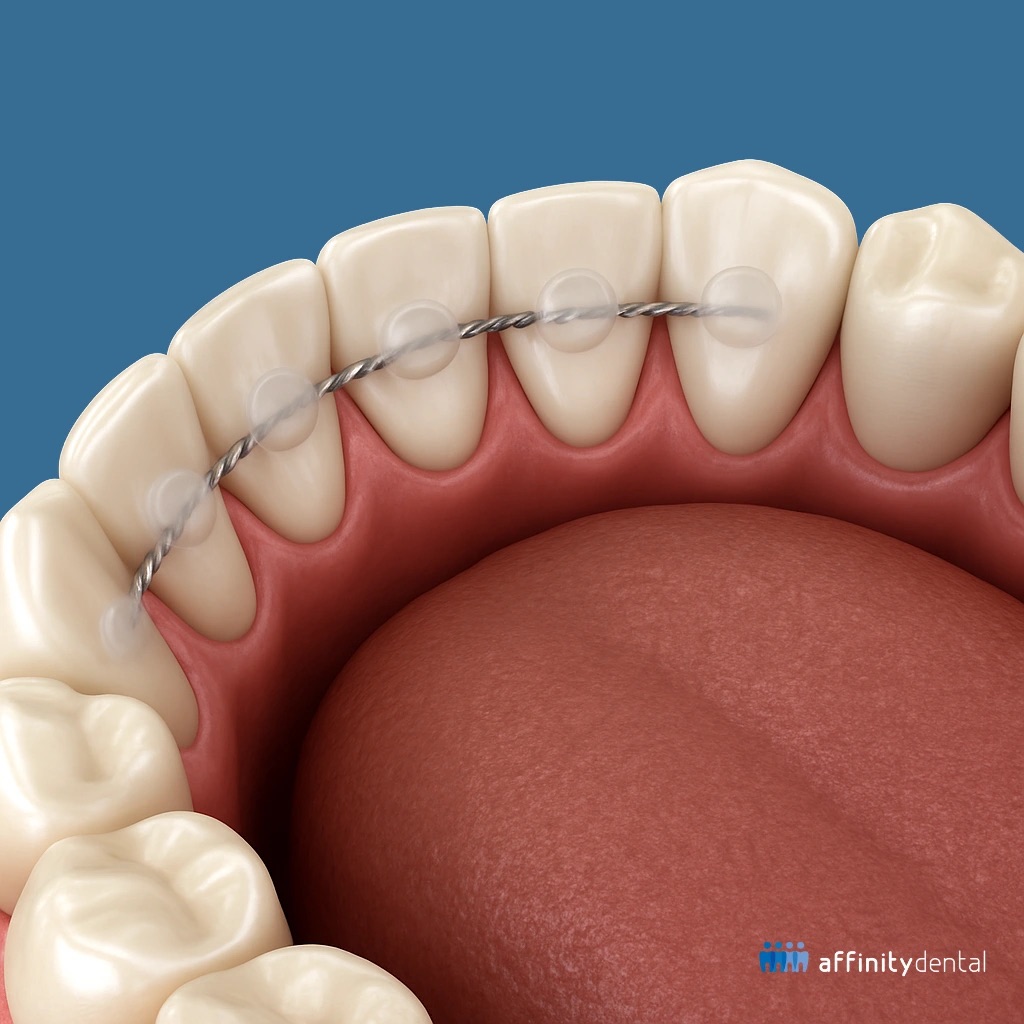
Does it really matter where you bond a fixed lingual retainer—or is the retainer design itself more important?
A 2026 in vitro study by Thaden et al. explored this question by comparing three different fixed lingual retainers bonded at incisal, middle, and gingival positions. The researchers measured the forces and labiolingual moments generated when the retainers were subjected to vertical displacement.
The surprising finding
We might expect a more gingivally positioned retainer to generate greater torque because of the longer lever arm. However, the study found no statistically significant difference in force or moment generation between the three bonding heights.
Instead, retainer type had a greater influence on the biomechanical response.
At 0.3 mm displacement:
- R1: round, multistranded stainless-steel retainer — lowest force/moment response.
- R2: flat, multistranded stainless-steel retainer — intermediate response.
- R3: CAD/CAM nickel-titanium retainer — generally higher force/moment response.
- Four of the original 45 specimens were excluded because of bonding failures.
- No retainer fractures occurred during testing.
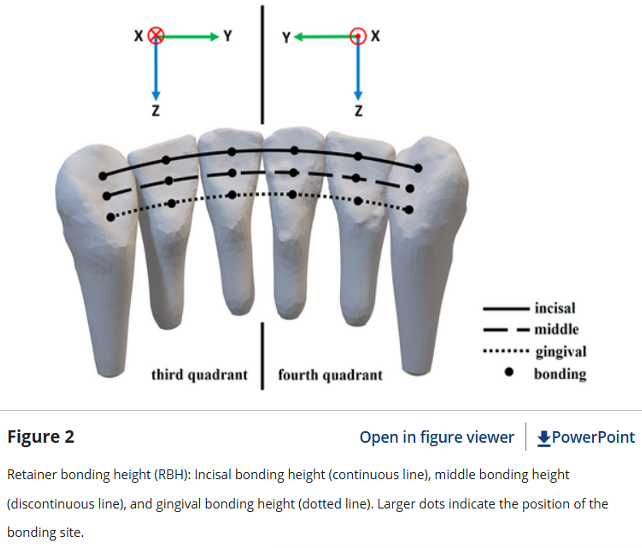
What does this mean in everyday practice?
The important message is not that bonding height is irrelevant. Rather, this study suggests that clinicians should avoid assuming that simply moving a retainer more incisally or gingivally will predictably change its biomechanical behavior.
When selecting and bonding a fixed retainer, consider:
- Retainer design and material: Different wires can behave very differently under loading.
- Wire flexibility: A low force response may indicate greater deformation rather than superior stability.
- Occlusal clearance: Especially important when choosing the vertical position of the retainer.
- Oral hygiene: The bonding position should allow the patient to maintain effective plaque control.
- Periodontal considerations: The position of the retainer and amount of adhesive may influence gingival health.
- Individual tooth position and inclination: Proclination or retroclination can alter the direction and magnitude of forces acting on the retainer.
- Composite thickness: The amount and geometry of adhesive may also influence load transfer.
A useful clinical takeaway
Don’t choose bonding height based on biomechanics alone.
The study supports selecting the most clinically appropriate position for the individual patient, while considering occlusion, hygiene, periodontal status, tooth morphology, and retainer design.
It is also worth remembering that this was an in vitro laboratory study. The retainers were exposed to a single controlled vertical loading cycle, rather than the complex, repetitive forces experienced during years of clinical function.
So, when a fixed retainer patient develops an inadvertent tooth movement, the explanation may be more complicated than simply asking, “Was the retainer bonded too gingivally?”
The retainer’s design, stiffness, deformation characteristics, bonding conditions, and the patient’s individual biomechanics may all be part of the story.
Bonding height alone did not significantly change force or moment generation in this laboratory model. Retainer type had a stronger effect.
For clinical practice, this means: choose the retainer and its position as part of the whole clinical picture—not on bonding height alone.
Reference
Effect of Bonding Height on Force-Moment Generation in Orthodontic Fixed Lingual Retainers: An In Vitro Study