Could a simple vitamin C injection offer a gentler approach to gingival depigmentation?
Gingival pigmentation is common and usually physiologic, but for patients with a high smile line, dark gingiva can become an important aesthetic concern. Traditionally, dentists have relied on techniques such as scalpel depigmentation, laser therapy, abrasion and electrosurgery.
Now, injectable vitamin C is emerging as an interesting minimally invasive option.
A recent case report described the use of 10% injectable vitamin C for physiologic gingival hyperpigmentation, with the patient reporting no pain and showing visible improvement after a short treatment course. While the findings are encouraging, dentists should interpret the results carefully because a case report alone cannot establish that the procedure is universally painless or superior to established techniques.
Why Is Vitamin C Being Used?
Vitamin C, or ascorbic acid, has antioxidant properties and has been investigated for its potential effects on melanin production.
The proposed rationale is that locally delivered vitamin C may influence melanogenesis and reduce the appearance of gingival pigmentation without surgically removing the superficial gingival epithelium.
This makes the technique particularly interesting for patients who prefer less invasive cosmetic periodontal procedures.
What Did the Recent Case Report Show?
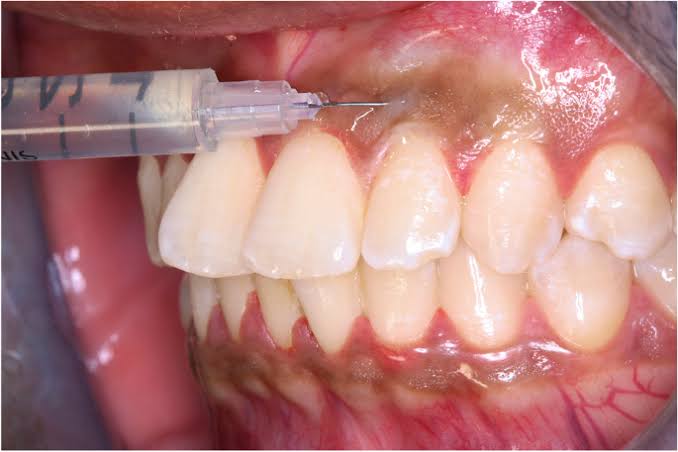
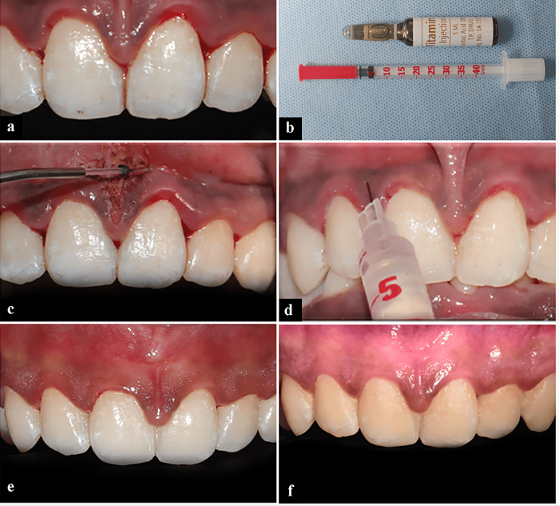
In the recently reported case, a young adult with physiologic gingival pigmentation received 10% injectable vitamin C through a fine-gauge syringe.
The treatment protocol involved:
- 10% vitamin C solution
- Approximately 1.25 mL of solution
- Delivery using a 30-gauge insulin syringe
- Multiple intramucosal injection points
- Approximately 2–3 mm spacing between injection sites
- Treatment performed once weekly for four weeks
The patient reported a VAS pain score of 0, while pigmentation improved from DOPI Grade 2 to Grade 1 at the one-month assessment.
These results are certainly interesting—but they should be viewed as preliminary clinical evidence rather than definitive proof.
Is Vitamin C Gingival Depigmentation Really Painless?
This is perhaps the most attention-grabbing part of the story.
The recent case reported zero pain, but other research suggests that patient experience can vary.
A clinical and histologic case series involving five patients reported a median pain score of 3/10 on the day of treatment.
A randomized clinical trial comparing injectable vitamin C with scalpel depigmentation found considerably lower pain scores with vitamin C, with reported VAS scores of approximately:
- Vitamin C: 0.73
- Scalpel: 3.33
Therefore, the more accurate clinical message is:
Vitamin C mesotherapy appears to be a low-pain, minimally invasive technique, but “painless” should not be promised to every patient.
What Are the Potential Advantages?
For selected patients, vitamin C therapy may offer several attractive features:
- Minimally invasive: No surgical removal of the gingival epithelium.
- Lower discomfort: Comparative studies suggest less pain than conventional scalpel techniques.
- Patient-friendly: The procedure may be appealing to patients who are reluctant to undergo periodontal surgery.
- Gradual aesthetic improvement: Pigmentation can decrease progressively over treatment sessions.
- Potentially high patient acceptance: Some comparative studies have reported favourable patient satisfaction.
- Simple clinical concept: The procedure uses a fine-gauge injection technique rather than surgical tissue removal.
But There Are Important Limitations
Despite the excitement surrounding vitamin C mesotherapy, it is important not to oversell the evidence.
Dentists should consider:
- Published studies use different concentrations and treatment protocols.
- The number of participants in many studies remains relatively small.
- Long-term evidence is still limited.
- The durability of pigmentation reduction requires further investigation.
- Repigmentation may occur.
- Treatment generally requires multiple sessions.
- Patient response can vary according to pigmentation severity and
Vitamin C injections represent an interesting and promising development in minimally invasive gingival depigmentation.
The available evidence suggests that locally delivered vitamin C can reduce gingival pigmentation and may produce less discomfort than scalpel depigmentation. However, the evidence base is still developing, and larger, standardized, long-term clinical trials are needed.
So, rather than describing it simply as a “painless gingival depigmentation technique,” a more scientifically responsible description would be:
A minimally invasive, low-pain approach with promising early clinical evidence.
References
- Aljahdali B, Dahlan R. Effectiveness of Vitamin C for Gingival Depigmentation: A Systematic Review. International Journal of Dentistry. 2026
- Injectable Vitamin C and Conventional Scalpel Surgery in the Management of Physiologic Gingival Hyperpigmentation: A Report of Two Cases
- A Minimally Invasive Technique for the Management of Physiologic Gingival Melanin Hyperpigmentation: A Case Series