Ever noticed how after a cold or illness, sweet taste returns first, while others feel dull for longer?
That’s not random —-your tongue is smarter than you think.
Recent research reveals something fascinating:
Certain “sweet-detecting” cells in your taste buds are built to survive damage and help rebuild your sense of taste.
What was the research about?
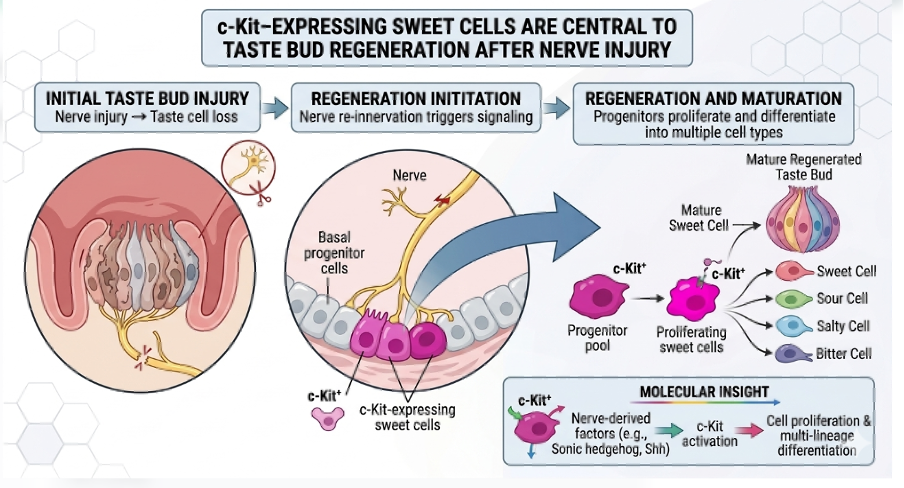
The study investigated how taste buds regenerate after nerve injury, a process that was known but poorly understood at the cellular level.
Taste buds depend on nerve supply. When nerves are damaged (due to infection, trauma, or surgery):
- Taste buds degenerate
- They later regenerate when nerves regrow
However, the mechanism behind this regeneration—especially which cells survive and drive recovery—was unclear.
This research aimed to identify:
- Which taste cells survive injury
- What molecular signals control regeneration
The study was led by:
- Dr. Dong-Hoon Kim
- Professor Yong Taek Jeong
How was the research conducted?
The researchers used:
- Mouse nerve injury models (to simulate taste nerve damage)
- Taste bud organoids (lab-grown models)
- Pharmacological testing using imatinib (a c-Kit inhibitor)
This allowed them to observe:
- Cell survival after injury
- Regeneration patterns
- Effects of blocking key signaling pathways
The Hidden Heroes: Sweet Cells
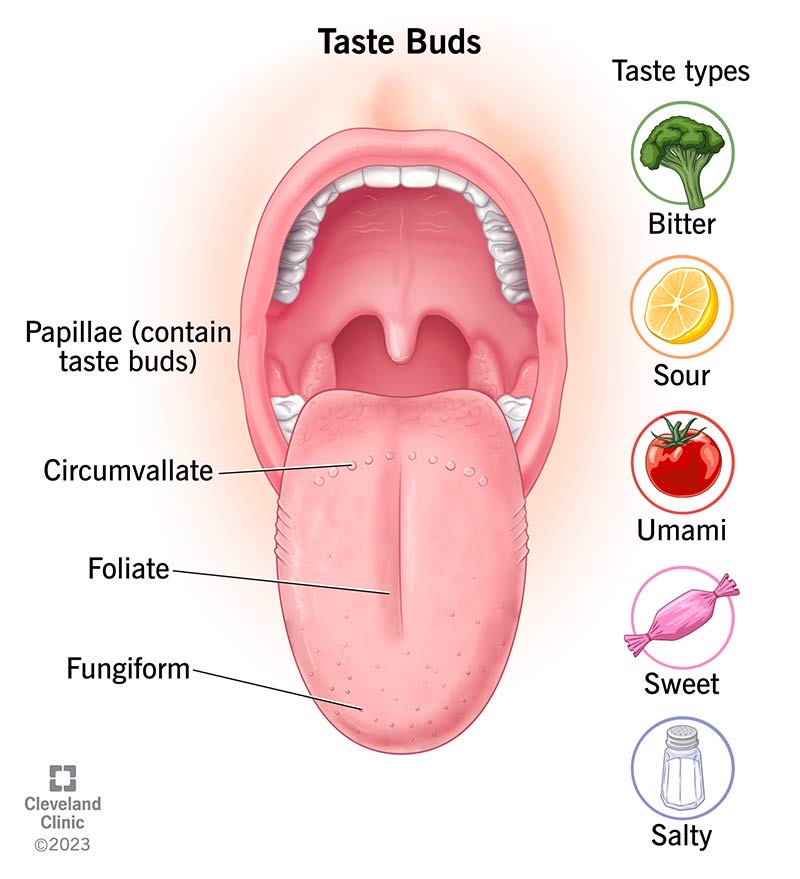
Inside your taste buds are different types of cells for sweet, salty, sour, bitter, and umami.
But here’s the twist:
- Sweet-sensing cells are the most resilient
- They survive even when taste nerves are damaged
- They act like “starter cells” that help regenerate the entire taste bud
These cells rely on a special protein called c-Kit, which acts like a survival switch.
Key Findings
1. Sweet taste cells are the most resilient
- A subset of taste cells (sweet-sensing cells) survived nerve injury
- Other taste cells degenerated more rapidly
2. c-Kit protein is the key survival factor
- These resilient cells express c-Kit (a receptor protein)
- c-Kit signaling helps them:
- Survive damage
- Initiate regeneration
3. Blocking c-Kit stops regeneration
- When c-Kit was inhibited using imatinib:
- Sweet cells disappeared
- Regeneration of other taste cells failed
Proves c-Kit is essential for recovery
4. Sweet cells act as “regeneration leaders”
- They don’t just survive — they help rebuild the entire taste bud system
- Other taste cells depend on them to regenerate
5. Supporting role of Type III cells
- Some Type III cells showed stem-like properties
- They helped repair surrounding tissue and epithelium
Why This Matters in Dentistry
This discovery isn’t just cool science — it has real clinical relevance:
Helps explain taste loss after oral surgery or nerve injury
- Important for managing:
- Lingual nerve damage
- Post-extraction taste disturbances
- Opens potential for:
- Targeted regenerative therapies
- Improved patient prognosis in dysgeusia
References
International Journal of Oral Science –
Ki SY et al. c-Kit signaling confers damage-resistance to sweet taste cells upon nerve injury
DOI: https://doi.org/10.1038/s41368-025-00387-3 (Nature)