A newly published study in explored one of the biggest questions surrounding modern endodontic irrigation systems:
Can simplified irrigation protocols preserve root strength while still delivering effective cleaning and disinfection?
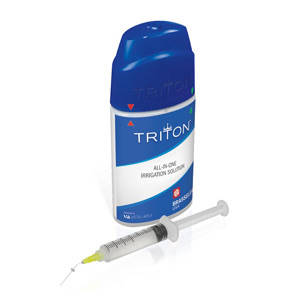
The spotlight was on Triton, a newer all-in-one irrigating solution designed to combine the actions of sodium hypochlorite, EDTA, and chlorhexidine into a single product.
Why This Study Matters
For years, endodontic irrigation has relied on multiple sequential solutions:
- Sodium hypochlorite (NaOCl) → tissue dissolution & antimicrobial action
- EDTA → smear layer removal
- Chlorhexidine (CHX) → long-lasting antimicrobial effect
While effective, these combinations can alter dentin structure over time, potentially affecting fracture resistance.
That’s where Triton enters the conversation.
According to the manufacturer, Triton:
- Uses lower-concentration NaOCl (4%)
- Contains mild chelators
- Includes surfactants for better penetration
- Functions as a single-step irrigation system
The goal?
Simpler workflow without compromising dentin integrity.
What Did Researchers Actually Do?
Researchers from Damascus University tested 64 extracted mandibular premolars.
The teeth were divided into 4 groups:
| Group | Irrigation Protocol |
| G1 | Triton all-in-one |
| G2 | NaOCl + EDTA + CHX |
| G3 | NaOCl only |
| G4 | Distilled water |
After root canal preparation:
- Teeth were subjected to fracture testing using a universal testing machine
- Force was applied until roots fractured
- Fracture patterns were analyzed
The Key Finding
Surprisingly, there was no statistically significant difference in fracture resistance between the groups.
Mean Fracture Resistance
- Triton group: 297.81 N
- Distilled water group: 364.50 N
- Difference was not statistically significant
This means Triton did not significantly weaken dentin compared with traditional irrigation systems.
What About Fracture Patterns?
Researchers observed:
- Oblique fractures most commonly
- Followed by vertical fractures
- Then comminuted fractures
Again, no major differences were seen between irrigation protocols.
Why Is This Interesting for Clinicians?
The study hints at a possible shift toward:
- Simplified irrigation workflows
- Reduced chairside complexity
- Lower risk of irrigation interaction errors
- Comparable mechanical safety
For busy clinicians, a single irrigant capable of:
- dissolving tissue,
- removing smear layer,
- and disinfecting canals
could significantly streamline endodontic treatment.
But There’s an Important Catch
This was still an in vitro study.
That means:
- No obturation was performed
- No chewing forces were simulated
- Long-term clinical performance remains unknown
The authors themselves acknowledged that future studies should evaluate:
- Different sealers
- Obturation quality
- Clinical simulation models
- Long-term fracture behavior
The Bigger Endodontic Debate
This study also reflects a larger trend in endodontics:
“Can we simplify irrigation without sacrificing outcomes?”
Modern endodontics is increasingly moving toward:
- continuous chelation systems,
- multi-functional irrigants,
- bioactive sealers,
- and workflow-efficient protocols.
Triton appears to be part of that evolution.
Whether it becomes mainstream will depend on:
- long-term evidence,
- antimicrobial superiority,
- clinical outcomes,
- and cost-effectiveness.
The newest generation of “all-in-one” endodontic irrigants may offer a more streamlined approach to canal disinfection — without significantly compromising root strength.
For now, Triton looks promising.
But as with many innovations in endodontics, the real test will come from long-term clinical evidence rather than laboratory data alone.
REFERANCE
Impact of Triton solution irrigation protocol on root fracture resistance: a comparative in vitro study of different irrigation protocols