Dental Innovation Retrieves Broken Root Canal Instruments with Minimal Tooth Damage
Anyone who performs root canal treatment knows the sinking feeling when an instrument fractures inside a canal. Removing a broken file or bur can be one of the most technically demanding procedures in endodontics. Traditional retrieval methods often require removing valuable dentin, increasing the risk of weakening the tooth or even pushing the fragment deeper into the root.
Now, recent scientific publications are drawing attention to a different solution—magnet-assisted retrieval.
A laboratory study introduced a novel electromagnetic retrieval device, while a 2026 clinical case report demonstrated the successful use of a small neodymium magnet to retrieve a fractured stainless-steel bur from a highly challenging tooth. Together, these studies suggest that magnetic technology could become a promising minimally invasive option in selected endodontic cases.
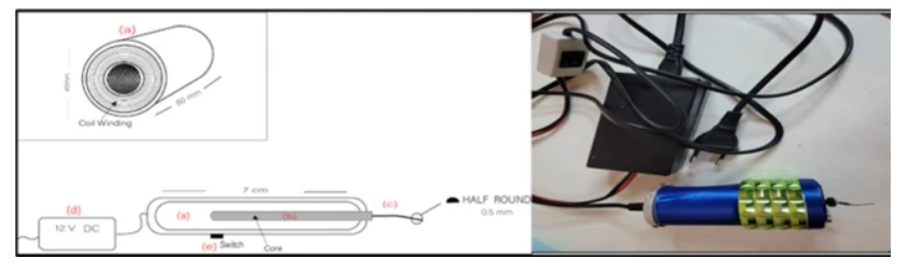
Working Model of the Electromagnetic Device.
Why Broken Instruments Are Such a Challenge
Instrument separation occurs in approximately 0.25% to 10% of root canal procedures, depending on canal anatomy, file type, and operator experience.
Retrieving these fragments is often difficult because clinicians must balance two priorities:
- Removing the obstruction
- Preserving as much healthy tooth structure as possible
Aggressive dentin removal increases the likelihood of vertical root fracture and compromises the long-term prognosis of the tooth.
Can Electromagnets Retrieve Broken Files?
Researchers led by Dr. Ashraf Mohammed Alhumaidi and colleagues developed an experimental electromagnetic device specifically designed to attract fractured stainless-steel endodontic files.
Study Highlights
- 180 extracted human teeth were tested.
- Stainless-steel K-files (#15 and #25) were intentionally fractured.
- Files were placed in the coronal, middle, and apical thirds of root canals.
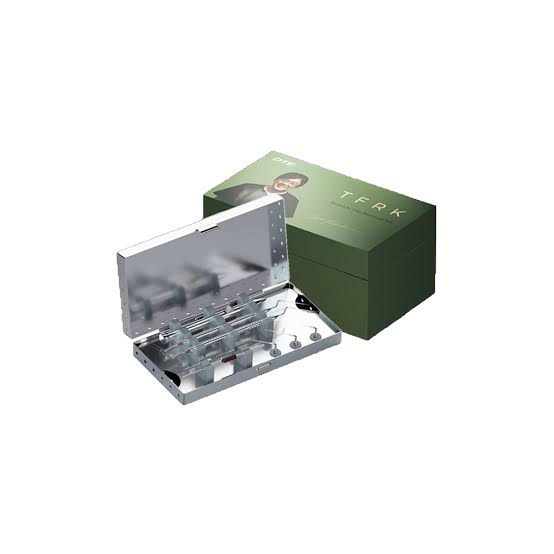
- Performance was compared with the widely used Terauchi File Retrieval Kit (TFRK).
Key Findings
100% retrieval success from the coronal third using the electromagnetic device.
Retrieval success declined as fragments were positioned deeper:
- Coronal third: 100%
- Middle third: 58–83%
- Apical third: 42%
The TFRK still performed better in deeper canals, particularly in the middle and apical thirds.
Perhaps most importantly, the electromagnetic device retrieved fragments without extensive circumferential dentin removal, suggesting a more conservative approach.
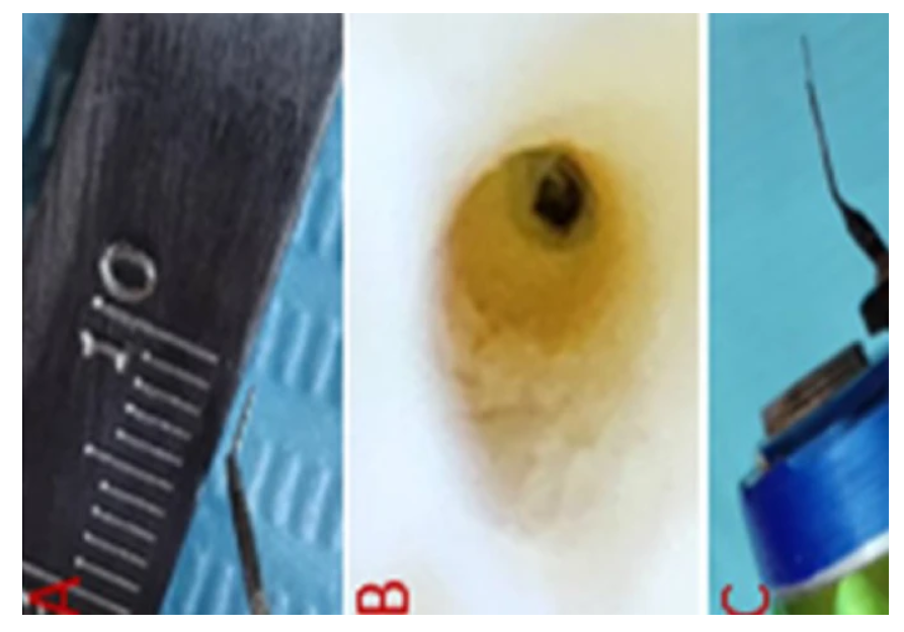
A 4 mm retrieved fractured instrument, B Intracanal broken instrument seen under magnification, C Broken instrument is attracted to the tip of the electromagnetic device
2026 Clinical Breakthrough: Magnet Saves a Complex Tooth
One year later, clinicians published a remarkable real-world case
The patient presented with:
- Necrotic maxillary lateral incisor
- Open apex
- Fractured stainless-steel bur displaced near the apex
Conventional retrieval techniques carried a significant risk of pushing the bur beyond the root or removing excessive dentin.
Instead, clinicians attached a small neodymium magnet to a hand file.
Under magnification, the magnet attracted the separated stainless-steel bur and removed it in one controlled movement without surgery.
Treatment was completed by placing:
- Mineral Trioxide Aggregate (MTA) apical barrier
- Thermoplasticized gutta-percha obturation
The patient experienced uneventful healing, demonstrating that magnetic retrieval can be successful in carefully selected clinical situations.
An Important Limitation
Magnetic retrieval only works with ferromagnetic materials.
Most modern rotary endodontic instruments are made from nickel-titanium (NiTi), which is not magnetic.
This means current magnetic techniques are primarily useful for retrieving:
- Stainless-steel files
- Stainless-steel burs
- Barbed broaches
- Gates-Glidden drills
- Stainless-steel endodontic instruments
Researchers believe future hybrid systems combining ultrasonic loosening with magnetic retrieval could improve success even in more complex cases.
Looking Ahead
These studies mark an exciting step toward more conservative endodontics.
While magnetic retrieval is not yet ready to replace established techniques, it demonstrates how engineering and dentistry are coming together to solve one of endodontics’ most frustrating complications.
With continued research and refinement, tomorrow’s dentists may retrieve broken instruments with less drilling, less stress, and better preservation of natural tooth structure.
Reference
- Bhagi S, Friend T. A novel magnetisation technique for the retrieval of a separated stainless-steel bur from an open apex upper lateral incisor: a case report. British Dental Journal. 2026;240:734–736.
- Novel electromagnetic device to retrieve fractured stainless steel endodontic files: an in-vitro investigation