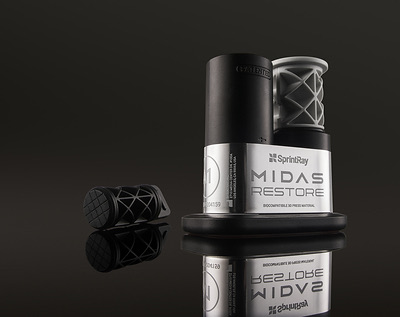
Chairside 3D printing is taking another step toward definitive restorative dentistry. SprintRay has commercially launched Midas Restore, an FDA-cleared, ceramic- and zirconia-filled restorative resin designed for the production of definitive crowns, inlays, onlays and veneers.
More Than 75% Filler Content
Midas Restore contains more than 75% filler by weight, combining glass ceramic and zirconia in a resin formulation.
According to SprintRay, the material was developed to provide a balance of strength, wear resistance, polish retention and optical properties suitable for definitive restorations.
The company reports a maximum biaxial flexural strength of 215 MPa, with a mean of 180 MPa, and surface hardness greater than 80 HV.
In laboratory testing, Midas Restore retained 98% of its initial gloss after 5,000 simulated toothbrush-abrasion cycles. SprintRay also reported five times the wear resistance of its Ceramic Crown material over 200,000 cycles, with performance comparable to a milled hybrid ceramic.
Designed for the Digital Workflow
A key feature of the system is SprintRay’s Digital Press Stereolithography (DPS) technology.
Highly filled restorative materials can be challenging to process using conventional vat-based 3D printing because of their viscosity. The Midas Digital Press uses sealed material capsules and actively moves the material into the print zone, allowing it to process formulations with filler loads exceeding 75%.
The chairside workflow combines:
Scanning → Digital Design → Production → Post-Curing → Polishing → Adhesive Bonding
SprintRay reports that restorations can be post-cured in approximately four minutes and polished in less than two minutes using two polishing wheels, without glazing or oven firing.
The material can also reportedly be adjusted, added to or repaired intraorally before adhesive cementation.
Availability
Midas Restore is available in A1, A2, A3, B1 and C2 shades and is validated for use with the Midas Digital Press and NanoCure.
In the United States, it is an FDA 510(k)-cleared Class II, prescription-only device (K260661).
Midas Restore represents an interesting development in chairside digital restorative dentistry, combining a highly filled ceramic/zirconia resin with a dedicated digital production system.
While the laboratory results reported by SprintRay are promising, long-term independent clinical data will be important in determining how printed definitive restorations compare with established milled and conventional restorative materials.
Reference
SprintRay Launches Midas Restore for Chairside 3D-Printed Restorations