Imagine losing a significant portion of your jawbone due to trauma, cancer, or disease—and instead of undergoing multiple complex surgeries, doctors simply print a custom-made scaffold that helps your own bone grow back.
What once sounded like science fiction is now becoming clinical reality.
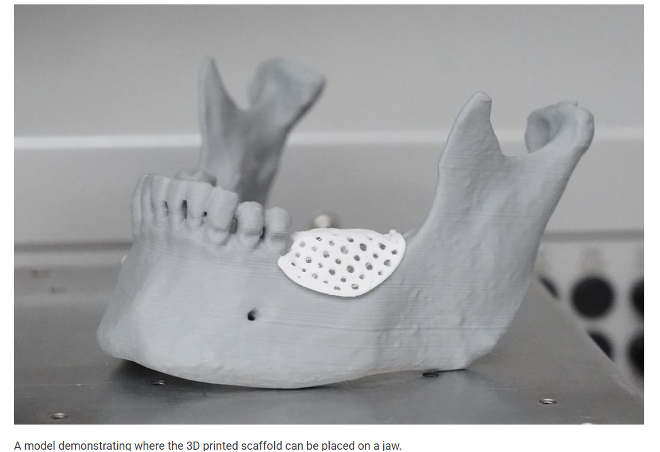
Researchers and clinicians at The University of Queensland have successfully used a patient-specific 3D-printed bone scaffold to rebuild part of a man’s jawbone, marking a significant step forward in regenerative dentistry and maxillofacial surgery.
From Missing Bone to New Bone
Traditionally, rebuilding large jawbone defects often requires harvesting bone from another part of the patient’s body, such as the hip or fibula. While effective, these procedures can involve additional surgery, longer recovery times, and increased complications.
The Queensland team explored a different approach.
Using advanced 3D printing technology, they created a custom scaffold designed to fit the patient’s defect precisely. The scaffold was produced using biocompatible materials that support natural bone regeneration while gradually integrating with the body’s healing processes.
The result? Successful reconstruction of part of the jaw without the need for a second surgery to remove the scaffold.
Why This Matters for Dentistry
For dentists, oral surgeons, and implant specialists, one of the biggest challenges is dealing with insufficient bone volume.
Bone loss can occur because of:
- Severe periodontal disease
- Trauma and accidents
- Tumor removal surgery
- Congenital defects
- Long-term tooth loss
Without adequate bone, procedures such as dental implants become significantly more challenging.
Custom 3D-printed scaffolds could potentially change that landscape by providing highly personalized solutions tailored to each patient’s anatomy.
A New Era of Personalized Regeneration
The real breakthrough isn’t just the scaffold itself—it’s the concept behind it.
Instead of adapting patients to available treatment options, clinicians can now design treatments around the individual patient.
Advanced imaging, digital planning, and 3D printing allow surgeons to create scaffolds that match the exact shape and dimensions of a defect, improving fit, stability, and healing potential.
This level of personalization could dramatically improve outcomes in reconstructive dentistry.
Beyond Jawbones: What’s Next?
Researchers believe the technology may eventually be applied to:
Large bone defects after tumor surgery
Complex facial reconstruction
Dental implant site development
Trauma-related bone loss
Craniofacial regenerative procedures
As biomaterials continue to evolve, future scaffolds may even carry growth factors, stem cells, or bioactive molecules that actively stimulate faster and more predictable bone regeneration.
The Bigger Picture
3D printing is rapidly transforming dentistry—from surgical guides and aligners to crowns and dentures. But regenerative applications like this may represent the most exciting frontier yet.
The successful use of a custom-made 3D-printed scaffold to rebuild a human jawbone demonstrates how digital dentistry is moving beyond restoration and into true tissue regeneration.
The question is no longer whether 3D printing belongs in dentistry.
Referance
UQ manufactures 3D printed scaffolding to rebuild jaw bones