ELIXIR™ by NovoLase is bringing a new idea to endodontics: instead of simply flooding the canal, can we use laser energy to reach the places conventional irrigation struggles to reach?
A root canal may look like a tiny tube.
But inside, it is anything but simple.
Lateral canals. Isthmuses. Fins. Dentinal tubules. Apical ramifications.
These microscopic spaces can make complete microbial control one of the biggest challenges in endodontic treatment.
And now, a new laser-assisted approach is attracting attention.
Meet ELIXIR™
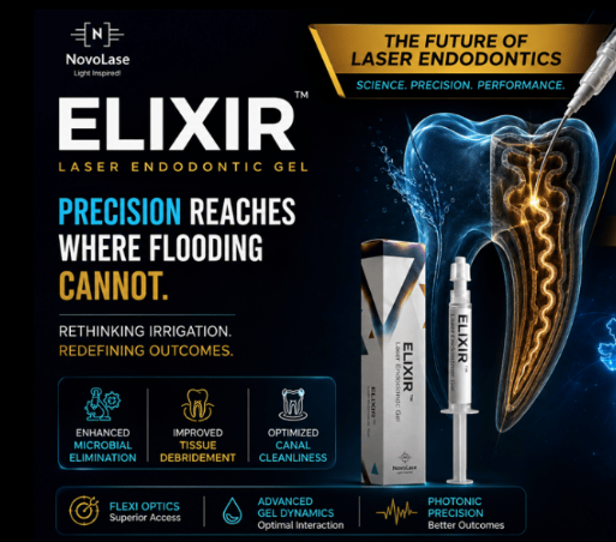
NovoLase has introduced ELIXIR™ — Endodontic Laser Irradiation for Xtended Intracanal Reconditioning™, a laser-assisted endodontic concept designed to complement conventional root canal disinfection.
“Precision reaches where flooding cannot.”
Rather than trying to replace sodium hypochlorite, EDTA or mechanical preparation, ELIXIR™ is positioned as an additional layer of disinfection.
The concept combines:
Laser photonics + flexible fibre delivery + specialized gel dynamics
to deliver controlled laser energy within the prepared root canal system.
Why Does This Matter?
Because bacteria don’t necessarily remain in the centre of the canal.
Microorganisms can survive in areas that are difficult for instruments and irrigants to access.
That is where laser-assisted endodontics becomes interesting.
Laser energy can interact with microorganisms and can also be used to activate irrigants or photosensitizing agents, potentially improving microbial reduction.
A 2024 clinical study involving 105 single-rooted teeth found significant reductions in microbial counts with several laser systems, and the combination of laser treatment with sodium hypochlorite produced greater microbial reduction than laser or NaOCl alone.
So the emerging idea isn’t:
Laser OR irrigation.
It is:Laser + irrigation.
The Science Behind the Concept
ELIXIR™ is built around three key ideas:
1. Photonics
Laser energy provides an additional mechanism for interacting with microorganisms and biofilms inside the canal.
2. Geometry
Root canals have complex anatomy.
Flexible optical delivery is intended to allow energy to be delivered more precisely within prepared canals.
3. Rheology
The ELIXIR™ concept also incorporates gel dynamics intended to influence how laser energy interacts within the canal.
Together, these concepts represent a shift toward precision-assisted endodontics.
But What Does the Latest Evidence Say?
This is where the story becomes even more interesting.
A 2026 systematic review and meta-analysis published in Frontiers in Oral Health evaluated 12 randomized controlled trials involving 863 patients.
The researchers found that diode laser-assisted irrigation showed potential advantages in bacterial reduction and some postoperative outcomes.
However, they also highlighted substantial variation in laser wavelengths, settings, protocols and study methods.
Their conclusion was cautious:
Laser technology may offer clinical advantages—but current evidence is not strong enough to consider it a proven superior replacement for conventional irrigation.
And this distinction matters when discussing ELIXIR™.
ELIXIR™ Is New. The Evidence Base Is Broader.
The research supporting laser-assisted endodontics is growing.
But that does not mean every new laser protocol or proprietary system automatically has the same level of clinical evidence.
The 2026 review specifically emphasized the need for standardized laser parameters and better-designed clinical trials before widespread adoption.
Therefore, ELIXIR™ should currently be viewed as an emerging technology built on a broader and evolving laser-endodontic evidence base, rather than as a technology whose specific clinical superiority has already been conclusively established.
If technologies such as ELIXIR™ continue to demonstrate predictable clinical outcomes, the future of endodontic disinfection could become increasingly focused on precision rather than simply increasing irrigant volume.
The biggest question isn’t whether lasers are exciting.
They are.
The real question is:
Can laser-assisted systems deliver a clinically meaningful improvement in long-term endodontic outcomes?
The current evidence suggests potential, but not a definitive answer yet.
And that is exactly why technologies like ELIXIR™ deserve attention—not as a replacement for evidence-based endodontics, but as part of the next generation of research into smarter, more targeted root canal disinfection.
The future of endodontics may not be about using MORE irrigation.
It may be about delivering the RIGHT energy, in the RIGHT place, at the RIGHT time.
Precision could be the next frontier in root canal disinfection.
Reference
NovoLase: Official information on its laser systems and endodontic applications