What if your apex locator could do more than determine working length?
Imagine using the tooth’s own electrical properties to locate a calcified canal—before unnecessary dentin is removed.
That is the fascinating concept behind the Micro Hole Negotiator (MHN) and the newly proposed impedance-guided localisation approach, recently explored by Dr. Mohammad Hossein Nekoofar and Prof. Paul M.H. Dummer.
Why does this matter?
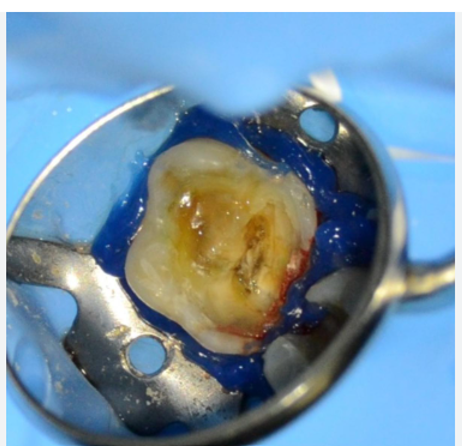
Calcified root canals remain one of the greatest challenges in endodontics. As the pulp space becomes progressively obliterated by mineralized tissue following trauma, aging, or irritation, locating the canal often becomes a delicate balance between preserving tooth structure and avoiding procedural errors.
Even with modern technologies such as:
- CBCT imaging
- Dental operating microscopes
- Ultrasonic troughing
- Static and dynamic guided endodontics
clinicians still rely primarily on visual and anatomical clues. These techniques reveal where the canal is expected to be, but they do not provide real-time biological feedback during access preparation.
Enter the MHN concept
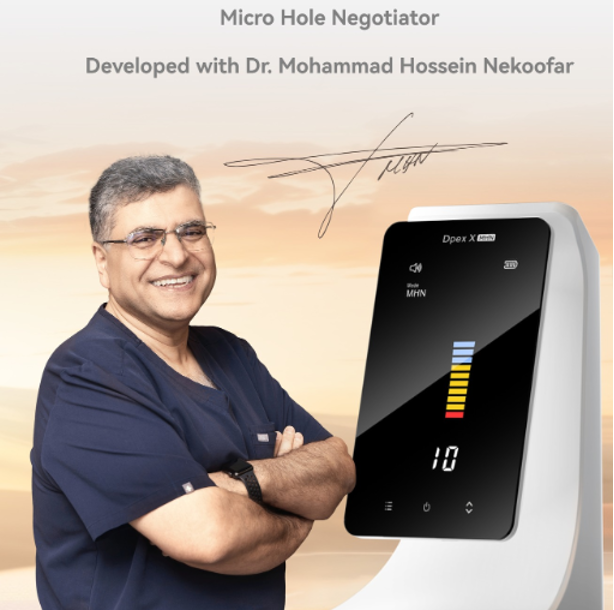
The Micro Hole Negotiator (MHN) introduces an entirely different philosophy.
Instead of relying solely on anatomy, it proposes using electrical impedance to identify conductive remnants of the pulp pathway hidden beneath calcified dentin.
The principle is straightforward:
- Healthy dentin is relatively insulating.
- Residual pulp tissue and tissue fluids conduct electricity.
- As an instrument approaches these conductive pathways, measurable impedance changes occur.
Rather than “searching blindly,” clinicians may eventually be able to follow a biological signal toward the pulp chamber and canal orifice
More than an apex locator
Electronic apex locators have successfully used impedance principles for decades to determine working length.
The MHN concept builds on these well-established electrochemical principles—but applies them at an earlier stage of treatment:
During access cavity preparation and canal localisation.
This transforms impedance from a tool used at the end of canal negotiation into one that could assist at the very beginning.
Why is this exciting?
If future clinical studies continue to validate the concept, impedance-guided localisation could potentially:
Reduce unnecessary dentin removal
Lower the risk of perforations and false pathways
Improve conservative access preparation
Assist clinicians when treating severely calcified canals
Enhance training for less experienced operators by providing real-time biological feedback
The publication also proposes an additional theoretical application: impedance measurements at the dentine–gutta-percha interface may one day help identify fluid leakage or compromised coronal sealing in root-filled teeth.
Where does the evidence stand?
It is important to recognize that this publication presents a conceptual and biological framework, rather than definitive clinical proof.
However, the concept is built upon decades of research into:
- Electronic apex locator technology
- Electrical impedance behaviour in dental tissues
- Conservative endodontics
- Management of calcified canals
Interestingly, a recent prospective clinical study evaluating the Micro Hole Negotiator reported encouraging results for locating the MB2 canal during maxillary molar retreatment, providing early clinical support for the technology’s potential.
Modern endodontics is steadily moving beyond simply “seeing” anatomy.
The future may involve listening to the biological signals within the tooth itself.
If impedance-guided localisation continues to evolve, it could represent one of the most innovative advances in conservative endodontics—combining engineering, electrochemistry, and biology to make challenging root canal treatment safer and more predictable.
Sometimes the smallest electrical signal may guide us to the biggest clinical breakthrough.
Key references
- Nekoofar MH, Dummer PMH. Impedance-Guided Localisation of Pulp Chambers and Canal Orifices in Calcified Root Canal Systems: Biological Foundations and Conceptual Application. International Endodontic Journal, 2026. (Wiley Online Library)
- Adıgüzel M, Özeken F, Çapar İD, Arslan H, Dummer PMH. Accuracy of Micro Hole Negotiator and Other Techniques for Detecting MB2 Canals in Maxillary Molar Retreatment: A Prospective Cohort Study. Australian Endodontic Journal, 2026. (PubMed)